 Hardanger Shop
Souvenirs
Hardanger souvenirs: what the name tells you
The word Hardanger on a souvenir is not a place of origin. Ask who made it, and where, before you carry it home or send it.
Send this on hardanger.shop/guide/en/hardanger-souvenirs
Hardanger Shop has Hardanger in its name, and nothing we sell is made in Hardanger.
- Protected food names with Hardanger in themSixBeskyttede betegnelser
- Hardanger Bestikk, production in Kinsarvik1958–2019NRK, Haugesunds Avis and the company’s own history
- I Love Odda, printed in the EUAbout halfof our orders since 2021
The word on the label
You are holding something with Hardanger on it. A fork, a roll of cloth, a mug. The word does not tell you where the thing was made, and nobody has promised you it does.
Take the cutlery. Hardanger Bestikk is Hardanger Sylvplett AS in the register, and it began in 1958 in a borrowed barn in Kinsarvik. Odd Leikvoll came from a silverware factory in Bergen, with the tools from it. In 15 square metres he made “lysestaker og souvenirskjeer i sølvplett”, candlesticks and souvenir spoons in silver plate. Souvenirs, then, made in Kinsarvik. In the 1970s came “skikkelige fabrikklokaler”, a proper factory, and the steel cutlery took off.
The knives always came from elsewhere, first from a factory in Germany and later from China. “Knivar har såleis aldri blitt produsert i Kinsarvik”, knives have never been made in Kinsarvik, wrote Hardanger Folkeblad in July 2009. That same summer the managing director, Odd’s son Rune Leikvoll, kept getting offers from Chinese factories that wanted to take over the rest. He said no. Today the company writes that it has worked with its two main factories “i Kina siden 2005 og i Vietnam siden 2017”, in China since 2005 and in Vietnam since 2017.
In January 2019 the staff were told. “Etter 60 år som bestikkprodusent i Kinsarvik i Hardanger, flyttes produksjonen til utlandet”, after 60 years making cutlery in Kinsarvik, production was moving abroad, reported NRK. “Min far og jeg har hele tiden sagt at vi skal være i Kinsarvik så lenge vi klarer å tjene penger”, said Rune Leikvoll: he and his father had always said they would stay as long as they could make money there. Christmas sales had failed, he said, and 160 retailers had closed the year before. On 25 April that year Haugesunds Avis wrote: “Produksjonen av bestikk i Kinsarvik er historie”, cutlery production in Kinsarvik is history. We have not found the last day at the machines.
What stayed is what comes before the factory. “Design- og produksjonsutvikling samt noe logistikk”, design and production development and some logistics, wrote FriFagbevegelse that January. That matches the company’s history page today: the products are “designet og utviklet ved familiebedriften i Kinsarvik”, designed and developed at the family firm. Its statement under the Transparency Act, signed in Kinsarvik on 7 June 2026, says “Hoveddelen av produksjonen skjer hos et lite antall leverandører i Asia”, most of the production is with a small number of suppliers in Asia, and that the company has 12 staff and offices in Kinsarvik and Bergen.
The name stayed when the factory moved. Today it tells you where the firm comes from and where the cutlery is drawn. Where the fork was made is a question to ask, and people ask Google too: “hvor er hardanger bestikk produsert”, where is it made. We have not picked up a fork to look. This is what the company and the papers have written.
The same word is on cloth. A shop in New York sells “Zweigart | 22 ct. Antique White Hardanger Fabric”, and a British one lists “Zweigart 22 Count Evenweave (Hardanger)”. Zweigart is in Sindelfingen and says its fabrics are made there, in Germany. It is the retailers who use the word. Hardanger embroidery was traditionally done on linen with linen thread, “begge deler dyrket og tilvirket lokalt”, both grown and made locally, says Store norske leksikon. Then the word told you something about the place. On a roll in New York it tells you which weave you get.
Now us. Hardanger Shop has Hardanger in its name, and nothing we sell is made in Hardanger. Our goods are printed to order and produced in the EU, as our questions and answers say. Our Hardangersøm design is a printed pattern, inspired by the embroidery. A wide apron border can take up to 180 hours to embroider, says the encyclopedia, and this is not that.
I Love Odda is in about half of the orders the shop has had since 2021, by our own sales figures. That is not many orders. But what people are buying is the name of a place, which is a fine thing to buy so long as you know that is what you are getting.
If you are looking for the shop in Kinsarvik, that is Hardanger Souvenir AS, org. no. 912 109 704. It is a different company from us.
Six names with a rule behind them
Beskyttede betegnelser, Norway’s protected designations, lists 40 approved products. Six have Hardanger in the name: Eplejuice or Eplemost frå Hardanger, Hardangerplommer, Hardangereple, Hardangermoreller, Hardangerpærer and Sider frå Hardanger. All six are tagged Geographic. The scheme “vektlegger den spesielle forbindelsen mellom et produkt og det geografiske området det kommer fra”, stresses the special connection between a product and the area it comes from, says its page about the mark.
For cider the rule is one sentence in the regulation: “Sider frå Hardanger er sider laga i Hardanger av eple dyrka i Hardanger.” Cider made in Hardanger from apples grown in Hardanger. That is the only regulation of the six we have read. Which bottle carries the name is in the bottle piece, and who makes it is in the cideries piece.
The regulation counts seven municipalities: Eidfjord, Granvin, Jondal, Kvam, Odda, Ulvik and Ullensvang, as they were before 2020. Store norske leksikon names four today on its narrow count: Ullensvang, Eidfjord, Ulvik and Kvam. The same landscape, counted two ways.
If you want a thing where Hardanger means Hardanger, buy food with one of those six names on it.
The shops that say who
Ask who made it, and where. If you get the name of a person, a farm or a workshop, you have your answer. If you get the word Hardanger again, you have an answer too.
Rosestova in Eidfjord sorts its own shelf: rose painting by local artists and the shop’s owner, locally produced honey, jam and chocolate, and then “eit utval av tradisjonelle suvenirar”, a selection of traditional souvenirs. That last group has no origin given, which is honest enough. The page also says the shop opens mainly for cruise calls, so check before you drive.
Kabuso in Øystese says both things in one sentence: “We focus on local, Norwegian-produced quality goods, but you will also find lovely items from further afield.” We would like to read that sentence in more shops.
At Hardanger Fartøyvernsenter in Norheimsund it is “hooks and candleholders forged in our blacksmith’s workshop, ropes made in the ropewalk”. The workshop is the maker, and you can see where. In Ulvik, Handelslaget is inside the tourist office, “a marketplace for local artisans”.
Buy food at the farm, or from a page that names the farm. Visit Hardangerfjord says cider, juice and jam can be bought “directly from the farms or stalls along the road and at local stores”. Opening hours move, so we do not print them.
Do not go to the tourist office in Odda to shop. Since 1 November 2026 it has been “No in-person service available”. Tourist goods are nothing new in the town. A 1911 photograph at DigitaltMuseum shows Anna Jordal’s costume shop, “etablert som ein turistbutikk”, set up as a tourist shop.
We have not stood at the counter of any of these shops for this piece, and we have not checked a shelf. This is what the shops write about themselves.
What goes in the bag
Jam and honey go in checked luggage. Avinor counts “jam and honey” as liquid, and unopened bottles too, and liquid in your hand baggage means “containers of max 100 ml”.
The bottle is harder. Check the airline before you pack one: “not all companies allow bottles in checked luggage”. The same page lists brown cheese, crackers and fresh fruit as allowed through security.
Through security is not the same as into the country. The United States says “Prohibited or restricted items may include meats, fresh fruits and vegetables” and that all agriculture items must be declared. That is one country, and it is not a yes or no on an apple. We did not find the rules for the EU or the UK on a page we could open, so we do not print them.
What you send
A cider from Vinmonopolet reaches a Norwegian address and no other. Vinmonopolet delivers to the post office or the door in Norway: “Vi leverer heller ikke til adresser utenfor Norge.” Nothing to addresses outside Norway.
For someone abroad, pick something that is not food or drink. Posten puts the check on you: “Det er du som har ansvaret”, it is your responsibility to check that the contents are legal to send, in Norway and abroad. The pages we read name neither alcohol nor food, so we are not saying it is banned. We are saying it is yours to find out.
If it has to arrive for Christmas, the delivery time is in the Christmas gift piece.
From the shop
Three things we sell: our own photograph, a printed pattern inspired by Hardanger embroidery and the name of Odda. All are printed in the EU.


We have no physical shop in Odda. What we make is printed to order and sent by post.
Sources
Checked 3 November 2026:
- Redegjørelse for aktsomhetsvurderinger 2025, Hardanger Sylvplett AS, org. no. 948 170 779, signed 7 June 2026.
- Vår historie, Gründer Odd Leikvoll and Arv og familie, Hardanger Bestikk.
- I 60 år har de laget bestikk i Hardanger, NRK Vestland, 11 January 2019.
- Hardanger Bestikk legger ned produksjonen i Norge, FriFagbevegelse, 15 January 2019.
- Kina vil overta produksjonen, Hardanger Folkeblad, 15 July 2009.
- Over 200 søkte da de lyste ut stillinger, Haugesunds Avis, 25 April 2019. Only the standfirst is open, and that is what we quote.
- Hardanger Souvenir AS, Enhetsregisteret.
- Godkjente produkter and Om beskyttede betegnelser: 40 products, six with Hardanger in the name.
- FOR-2009-04-17-420, Lovdata. Sider frå Hardanger and the seven municipalities.
- Hardangersøm and Hardanger, Store norske leksikon, both updated 24 February 2025.
- Zweigart, Hobby House Needleworks and Wool Warehouse. The Zweigart pages we read do not use the word Hardanger.
- Rosestova, Ulvik, Taste Hardanger this autumn and tourist information in Ullensvang, Visit Hardangerfjord.
- Gift shop, Kabuso, and café and gift shop, Hardanger Fartøyvernsenter.
- Anna Jordal’s costume shop, DigitaltMuseum, photograph from 1911.
- Baggage rules, Avinor.
- Agricultural items, U.S. Customs and Border Protection, modified 30 December 2025.
- Levering, Vinmonopolet, updated 6 October 2026.
- Forbudt innhold, Posten.
- Hardanger Shop, questions and answers: printed to order and produced in the EU.
- Hardanger Shop, own sales figures, export read 3 November 2026: I Love Odda is in about half of the orders since 2021.
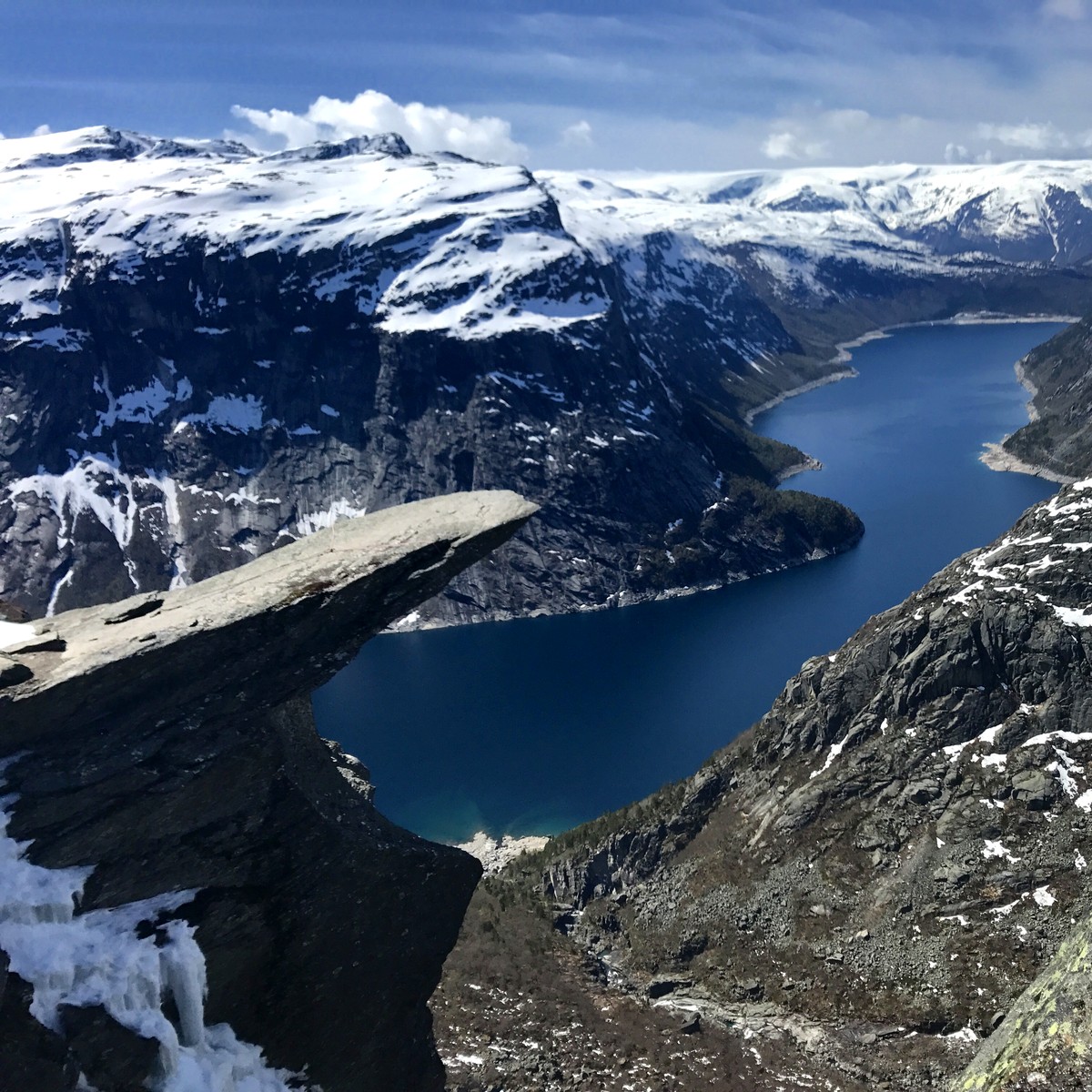
- The picture at the top is ours, taken 15 May 2017.